
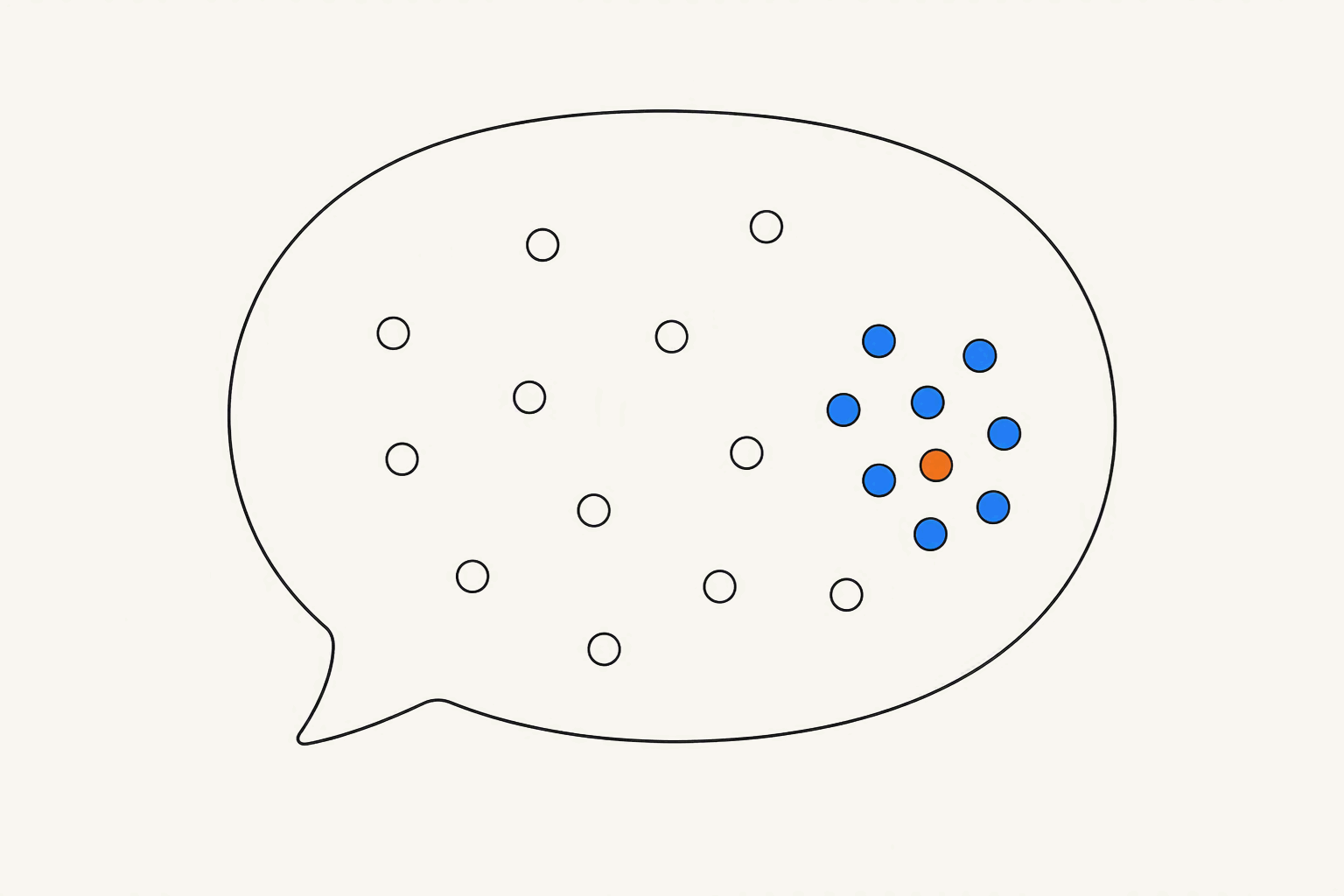
AI share of voice is your brand's share of all brand mentions in the AI answers to your category's questions. To calculate it, divide your brand's mentions by the mentions of all the brands you track, then multiply by 100.
Say the answers from ChatGPT, Gemini and Perplexity name the brands you track 80 times in total, and 18 of those mentions are yours. Your AI share of voice is 18 ÷ 80 × 100 = 22.5%. The number shows how much of the shortlist you hold against your competitors.
In marketing, share of voice first meant a brand's share of the advertising in its category. In AI search it measures how often engines pick your brand, out of the brands you compete with, when a buyer asks what to choose.
What is the share of voice formula?
The share of voice formula divides one brand's mentions by the mentions of every brand in the set, then multiplies by 100. Depra counts a mention as an AI answer that names the brand. The shares of all tracked brands add up to 100%.
Tools can define share of voice differently, for example by counting every repeat of a name or by weighting mentions by position in the answer. Check how a tool counts before you compare its numbers with another tool.
AI share of voice = mentions of your brand ÷ mentions of all tracked brands × 100 (the formula Depra uses)
How do you calculate AI share of voice?
Here is the calculation with four made-up brands. Acme is your brand. Rival A, Rival B and Rival C are the competitors you track. You ask 20 buying questions to ChatGPT, Gemini and Perplexity once each.
- Collect the answers: 20 questions × 3 engines = 60 answers.
- Count mentions per brand: count a brand once for each answer that names it, however many times that answer repeats the name. Acme is named in 18 answers, Rival A in 30, Rival B in 24 and Rival C in 8.
- Add up all mentions: 18 + 30 + 24 + 8 = 80 mentions of tracked brands.
- Divide and multiply by 100: Acme's share of voice is 18 ÷ 80 × 100 = 22.5%. Repeat for each brand. The four shares add up to 100%.
| Brand | Answers that name it | Visibility | Share of voice |
|---|---|---|---|
| Acme (you) | 18 of 60 | 30% | 18 ÷ 80 = 22.5% |
| Rival A | 30 of 60 | 50% | 30 ÷ 80 = 37.5% |
| Rival B | 24 of 60 | 40% | 24 ÷ 80 = 30% |
| Rival C | 8 of 60 | 13.3% | 8 ÷ 80 = 10% |
| All tracked brands | 80 mentions | n/a | 100% |
What counts as a mention in Depra
- Only brands you track count toward the total. Depra also lists brands that AI keeps naming and you do not track, so you can add them as competitors in one click.
- A brand counts once per answer, however often the answer repeats it.
- Every mention is backed by the quoted sentence from the answer. Depra uses an AI model to read each answer, and a mention it is less than 50% sure about never counts.
- Questions that already contain your brand name are left out by default, because they return your brand almost every time.
- Google shows an AI Overview, the AI summary above the search results, for only some searches. When there is none, that search stays out of the calculation.
What is the difference between share of voice and visibility?
Visibility is the share of answers that name you. Share of voice is your share of all brand mentions in those answers. Visibility compares you with the answers. Share of voice compares you with your competitors.
In the example, Acme's visibility is 30% (18 of 60 answers) and its share of voice is 22.5% (18 of 80 mentions).
The two can move in different directions. Say that next month Acme is still named in 18 of 60 answers, and Rival C climbs from 8 answers to 28. Total mentions rise to 100, so Acme's share of voice falls to 18% while its visibility stays at 30%. AI named Acme just as often. A competitor took a bigger part of the shortlist.
Track both. Visibility tells you whether AI names you at all. Share of voice tells you how you rank against the brands you compete with. The full list of scores is in how Depra measures AI visibility.
| Metric | Month 1 | Month 2 |
|---|---|---|
| Answers that name Acme | 18 of 60 | 18 of 60 |
| Acme visibility | 30% | 30% |
| Answers that name Rival C | 8 of 60 | 28 of 60 |
| Mentions of all tracked brands | 80 | 100 |
| Acme share of voice | 22.5% | 18% |
Why does AI share of voice change from run to run?
AI engines do not return the same brand list every time. When we asked ChatGPT 10 buying questions, in English and Hinglish, 8 times each from inside India within one hour, two answers to the same question shared 54.7% of the brands they named on average, as reported in does ChatGPT give the same answer to everyone.
A share of voice worked out from a handful of answers can move several points with no real change, and more answers make it steadier. Depra asks your questions on a schedule, daily for ChatGPT, Gemini and Google AI Overviews and weekly for Perplexity, and computes every score from all the stored answers in your date range.
Your report shows share of voice with the mention counts behind it, such as 18 of 80 mentions. It also shows a 95% confidence range for visibility, which is the band the true figure most likely sits in. Treat a small move on a small sample as noise.
How do you raise your AI share of voice?
Your share of voice rises when AI names you in more answers, or names competitors in fewer. You control the first. Start from what AI engines already cite for your questions, where a citation is a web page an answer links to as a source.
- Get onto the sites AI cites: find the websites AI cites when it recommends your competitors but never when it names you, then pitch, list or review your way onto them. Depra runs this as a citation gap analysis.
- Publish the page formats AI cites: if comparison pages and "best X for Y" lists make up most citations for your questions, publish those formats on your own site.
- Let AI search crawlers in: robots.txt is the file that tells bots which pages they may fetch. If it blocks OAI-SearchBot or PerplexityBot, those engines cannot fetch your pages to cite them. The AI crawlers guide lists each bot.
How Depra ranks the next moves
Depra turns your stored answers into a ranked list: up to 12 places to get mentioned and up to 12 page formats to publish, each with the evidence behind it. When you mark one done, it shows your visibility before and after. That comparison does not prove the action caused the change. See the AI action plan.
How do you track AI share of voice by engine and language?
Track share of voice per engine. ChatGPT, Gemini, Perplexity and Google AI Overviews cite different sources and name different brands, so one pooled figure can hide a strong engine and a weak one.
In Depra, share of voice sits next to visibility, average position and sentiment on your overview and in the competitor ranking table, with the change since the previous period. Filter to one engine and the numbers recalculate for that engine alone. Open a single question to see share of voice for that question. Perplexity is checked weekly and the other three daily, so a pooled figure holds more ChatGPT, Gemini and AI Overview answers than Perplexity answers.
For brands selling in India, language matters too. Hinglish is Hindi and English typed in English letters, such as "sabse accha protein powder kaunsa hai". Depra tracks Hinglish versions of your questions next to the English ones, and your report shows visibility for each language side by side.
The gap can be large. In our study of 480 answers from India, Gemini cited sources in 90.0% of English answers and 41.3% of Hinglish answers (English vs Hinglish study). How Depra measures each engine is on the AI visibility tracker page.