
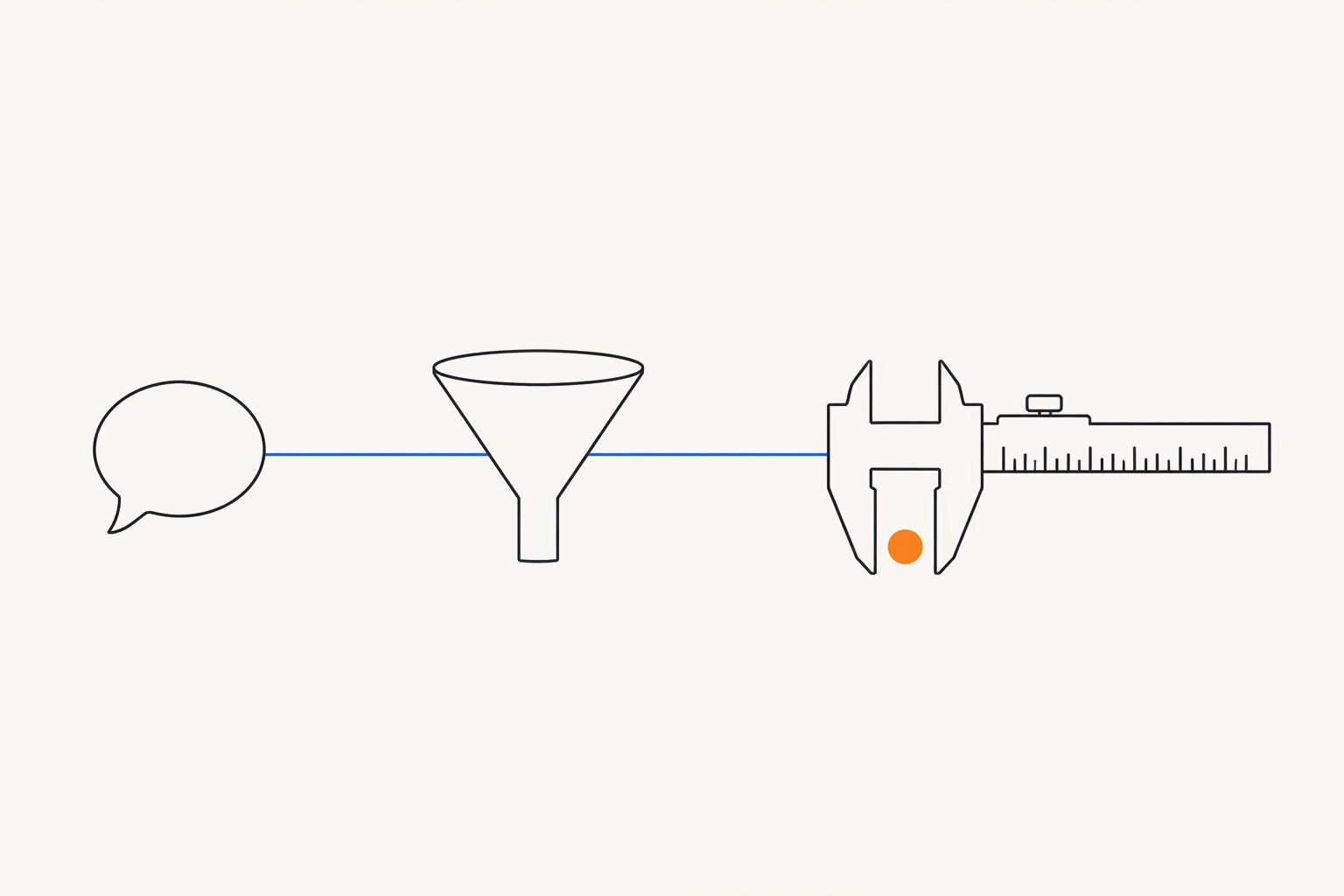
Depra takes the questions your buyers ask ('best body balm under ₹3,000'), asks them to four AI engines from inside your chosen country, stores every full answer, and records whether each answer named you, in what order, in what tone, and which web pages it cited. Scores are computed from those stored answers, with the number of answers behind them attached.
This page sets out each step, the rules that decide what counts, and the limits of the method. A prompt here means one buyer question that Depra tracks.
Which AI engines does Depra check, and how are answers captured?
Depra checks four engines. ChatGPT and Gemini answers are captured from the consumer web interfaces at chatgpt.com and gemini.google.com, so you see the answers real people see there. Google AI Overviews, the AI-written summary Google shows above some results, are read from a real Google results page. Perplexity is checked through Sonar, its own answer model with live web search.
The step-by-step capture process is in how Depra captures AI answers.
| Engine | What is captured | How often |
|---|---|---|
| ChatGPT | The answer shown in the chatgpt.com web app, with web search switched on so it cites sources | Daily |
| Gemini | The answer shown in the gemini.google.com web app | Daily |
| Google AI Overviews | The AI Overview block on a real Google results page for the query in that country, its source links, and whether an Overview appeared at all | Daily |
| Perplexity | The answer from the Sonar model with live web search, set to the country | Weekly |
Where are the questions asked from?
Each question is asked from inside the country you choose, at country level. Depra supports 40 markets: India, the United States, the United Kingdom, Ireland and 29 other European countries, 6 Gulf countries and Australia.
A project can track up to 10 markets. A prompt tracked in 2 markets uses 2 of your plan's prompts.
Depra does not target cities, simulate personas or use a logged-in account with chat history. Every check is a fresh question from that country with no personal history, so every day's checks run under the same conditions and can be compared.
Which questions are counted?
When you set up a project, Depra suggests 5 topics with 8 buying questions each, 40 in total, written the way a buyer would type them. None of the suggested questions name your brand. You can add, edit, pause and tag prompts.
When India is one of your markets, Depra also suggests Hinglish versions. Hinglish is Hindi and English typed in English letters, such as 'sabse accha protein powder kaunsa hai', and Depra always writes it in the Latin alphabet.
Prompts that already contain your brand name are left out of your scores by default. A question like 'is Brand X any good?' almost always returns Brand X, so counting it would inflate visibility.
How are brand mentions read from each answer?
Depra reads every stored answer. For each tracked brand the answer names, it records four things.
- Position: the order in which the brand is first named, where 1 means named first.
- Sentiment: whether the answer describes the brand positively, neutrally or negatively.
- Quote: the exact sentence that names the brand, so you can check every mention.
- Confidence: how sure Depra is that the text refers to the brand.
What counts as a mention
- A brand is matched on its tracked names, which can include other spellings and its domain, so "depra.ai" can count as Depra AI.
- A brand name found inside a longer word does not count, so 'Ola' inside 'Motorola' is not a mention of Ola.
- A mention without a supporting quote from the answer is dropped.
- A mention below 50% confidence never counts towards any score.
- The language of each reply is detected separately from the language of the question, because engines often answer a Hinglish question in English.
How are the scores calculated?
Every score is computed from the stored answers in the date range you pick, and compared with the previous period. A competitor is only scored on answers collected after you started tracking it.
| Score | What it tells you | Calculation |
|---|---|---|
| Visibility | How often AI names you | Answers that name the brand, divided by all answers in the period |
| Share of voice | Your share of all brand mentions in the answers (AI share of voice explained) | Mentions of the brand, divided by mentions of all tracked brands |
| Average position | Where you come in the list when AI names options | Mean first-mention position across mentions of the brand |
| Sentiment | Whether AI talks about you warmly, neutrally or critically | Positive = 100, neutral = 50, negative = 0, averaged across mentions |
Confidence ranges and sample size
AI engines can name different brands when the same question is asked twice, which is covered in whether ChatGPT gives the same answer to everyone. So a score is only as precise as the number of answers behind it.
Your report shows a 95% confidence range for visibility, the band the true figure most likely sits in, next to the number of answers. At 50% visibility, 20 answers give a range of about 30% to 70%. 400 answers narrow it to about 45% to 55%.
What the daily brief reports
The daily brief is an in-app page that lists what changed since the previous scan day. It reports a visibility change only when the two days' 95% ranges do not overlap, and only when each day has at least 5 answers. Smaller moves are normal run-to-run noise and stay out of the brief.
What happens when Google shows no AI Overview?
Google does not show an AI Overview for every search. When no Overview appears, Depra stores that as its own result and keeps it out of visibility, so a missing Overview never counts as an answer that left you out.
Your report shows it separately: how often Google showed an AI Overview at all for your questions.
What happens at the monthly run ceiling?
Each plan has a monthly ceiling on runs, where one run is one engine answering one prompt in one market. Starter allows 2,400 runs a month, Growth 11,000, Scale 19,000 and Enterprise 40,000.
If your account reaches its ceiling, scheduled checks drop to weekly for the rest of the month, so data keeps coming in. A one-time pack of 1,500 extra checks costs ₹1,499. Plan details are on Depra pricing.
What are the limits of this method?
- Engines not tracked: Google AI Mode, Claude, Microsoft Copilot, Grok, DeepSeek and Meta AI. Questions typed in Hindi script are not tracked; Hinglish is.
- ChatGPT with search on: answers are captured with web search switched on, so answers a user gets with search off are not measured.
- Perplexity through its API: Perplexity answers come from the Sonar model with live search, which can differ from the Perplexity app.
- Cited pages only: Depra stores the pages an answer cites. It cannot see pages an engine read and chose not to cite.
- No search volume: Depra does not estimate how many people ask each question.
- Country level only: no city targeting, personas or logged-in chat history.
- Before and after only: when you mark an action done, Depra shows your visibility then and now. That comparison does not prove the action caused the change.
Where can I check Depra's published research?
Depra publishes open research with its data and code. The first study asked 10 buying questions (5 skincare, 5 fashion) in English and in Hinglish, 8 times each, to ChatGPT, Gemini and Perplexity from inside India: 480 answers, with fieldwork on 14 August 2026.
It measured how much each engine's brand list changes between English and Hinglish, beyond its normal rerun noise: 2.2 points for ChatGPT, 7.8 for Gemini and 23.4 for Perplexity. Read the English vs Hinglish AI shopping study or check the study data and code on GitHub.